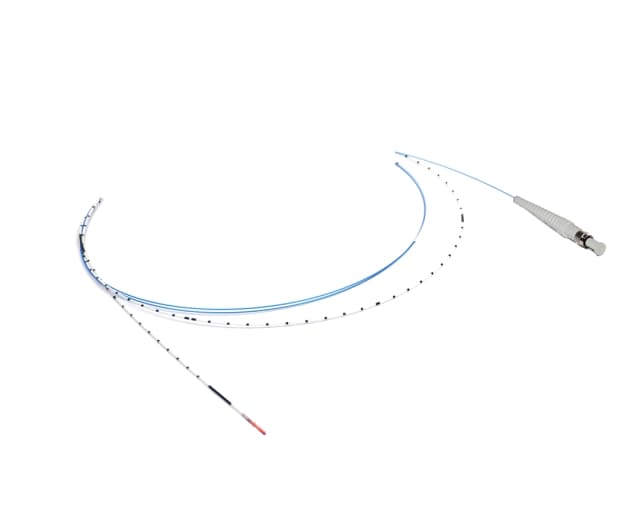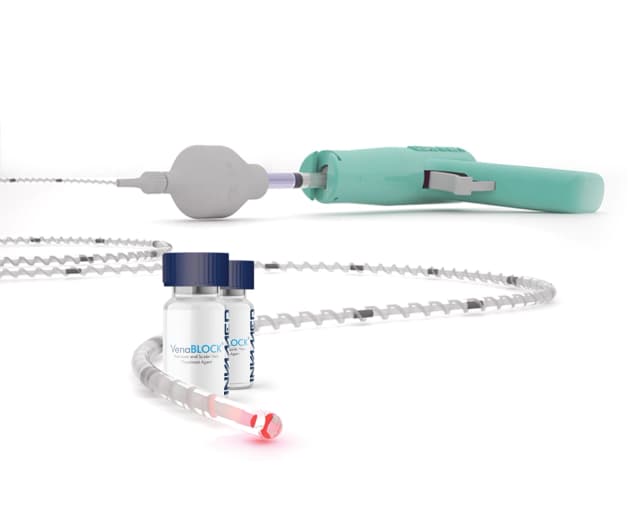
VenaBLOCK® offers a distinct approach to managing venous insufficiency by delivering cyanoacrylate adhesive directly into the diseased vein segment (e.g., great saphenous vein, small saphenous vein, or perforator veins). Through a continuous application of the adhesive under controlled pressure over the target vessel segment, VenaBLOCK® aims to close the dysfunctional vein with minimal invasiveness and rapid procedure times.
Cyanoacrylate Closure Mechanism
Permanent Vein Closure: Injecting cyanoacrylate into the incompetent vein produces a stable polymer seal, reducing reliance on thermal ablation or surgical ligation.
Targeted Delivery: Provides immediate and durable adhesion, with typically minimal post-procedure discomfort.
Dual-Lumen Catheter System
0.5 mm internal diameter (ID) for cyanoacrylate injection.
0.9 mm ID for laser or other adjunct therapy, if required.
Versatile Applications: Catheter design accommodates both adhesive infusion and laser guidance (or other device) in a single session, facilitating multi-modal intervention.
Laser-Guided Catheter Shaft
Braided Reinforcement: Incorporates a PTFE-lined interior with an outer braided 4F–6F-diameter shaft for structural stability.
Marked Every 2 cm: The 100 cm catheter includes 2 cm markings, aiding consistent depth control and precise adhesive placement.
Minimally Invasive Delivery
Advanced Tip & Pressure: By coordinating continuous cyanoacrylate delivery and external vein compression, the solution spreads evenly along the vein’s interior, ensuring uniform closure.
Reduced Thermal or Surgical Stress: Minimizes patient discomfort and accelerates post-procedure recovery compared to conventional stripping or thermal ablation methods.
Clinical Evidence
The VenaBLOCK cyanoacrylate closure system is one of the most extensively studied non-thermal, non-tumescent venous closure platforms:
- Twelve-month results in 538 patients (Vascular, 2018) — procedural success was 100% and the Kaplan-Meier occlusion rate was 99.4% at 12 months; Venous Clinical Severity Score fell from 5.43 to 0.6 with no skin pigmentation, paresthesia, deep vein thrombosis, or pulmonary embolism reported. DOI: 10.1177/1708538118770548
- Comparative analysis of VenaBlock and VenaSeal systems (International Angiology, 2024) — across 1,882 VenaBlock-treated extremities in 11 published studies, cumulative recanalization-free survival was equivalent to the comparator through 60 months, with significant improvement in clinical severity and quality-of-life scores. DOI: 10.23736/S0392-9590.24.05143-5
Browse the full INVAMED Clinical Evidence Library for source-linked study data.
.webp&w=640&q=75)