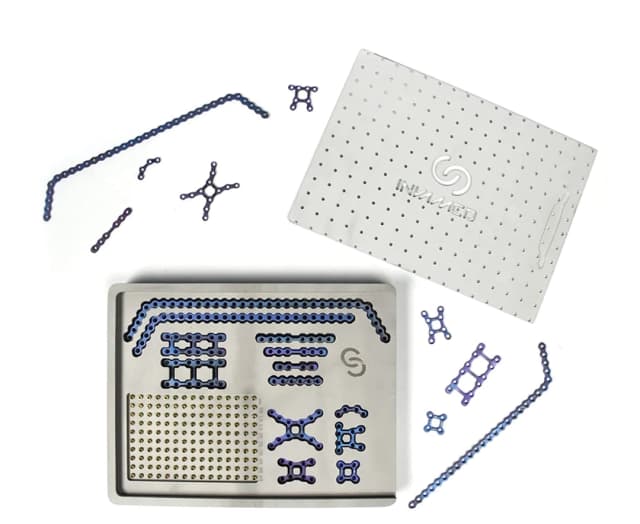
The PetaⓇ Sternum Closure Plate addresses the challenges associated with fixating a 90-degree sternal incision or rib osteotomy through an anatomically contoured, low-profile design. Constructed from a highly biocompatible Ti-6Al-4V-ELI alloy and featuring a user-friendly locking block, PetaⓇ provides secure and re-tensionable closure, ensuring optimal stability and patient comfort.
- Minimally Invasive Access: The plate’s thin profile accommodates incisions in tight anatomical spaces, lessening postoperative discomfort and risk of soft tissue irritation.
- Anatomical Contouring: Engineered to conform seamlessly to the curvature of the sternum or rib, enhancing implant stability while preserving natural bone alignment.
- Highly Biocompatible: The titanium alloy demonstrates excellent osseointegration and minimal inflammatory response, making it suitable for long-term surgical implants.
- Secure Lock Mechanism: Once fixed by the locking-block screw, there is no risk of self-loosening or accidental opening—critical for maintaining consistent compression across the osteotomy site.
- Re-Tension Capability: The locking block screw can be loosened intraoperatively to re-tension the plate, streamlining adjustments and shortening operating room time.
- Advanced Imaging Safety: MR compatibility ensures that patients requiring postoperative MRI can undergo imaging with minimal artifact and without necessitating plate removal.
- Clinically Versatile: This feature is especially valuable for complex cases that demand ongoing multimodal imaging for diagnosis or follow-up.
Technical Advantages
The rigid fixation achieved through titanium alloy construction and a low-profile locking system improves bone healing and reduces micromotion, crucial factors in preventing non-union or delayed union.
An anatomically contoured plate can decrease soft tissue irritation, potentially lowering patient discomfort and accelerating recovery timelines.
The ability to modify or re-tension the locking block screw intraoperatively offers precise control over compression, alignment, and overall surgical outcome.
Multiple plate lengths and shapes (depending on the system’s available catalog) enable surgeons to tailor the fixation construct to specific patient anatomies and surgical approaches.